How Kino works
A short, simple guide to making your first video. No experience needed.
What is Kino
Kino turns a written idea into a short AI video, about five to fifteen seconds long, complete with sound. Type what you want to see, and Kino generates the picture and the audio to match.
Create your first video
Making your first video takes three steps.
- Describe what you want to see in the Create box.
- Add a photo if you want Kino to use it as a reference or a starting frame. This step is optional.
- Tap Generate video and watch your video come together.
- Pick a mode at the top of the Create card: Character, Animate image, or Text to Video, then describe what you want to see.
- Open the settings row under the text box to set the duration, the format and the quality. Add a photo if your mode uses one.
- Check the credit cost next to the Generate video button, then click it and watch your video come together.
New accounts start with free credits, so you can try this right away.
Animate a photo
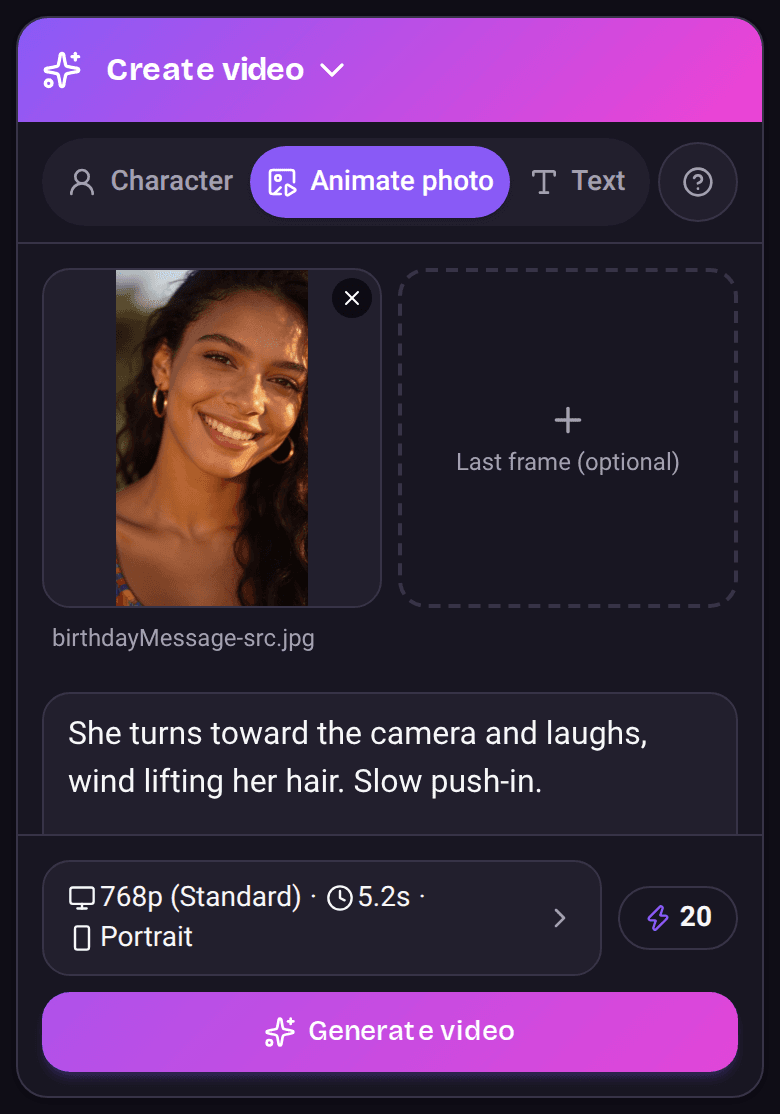
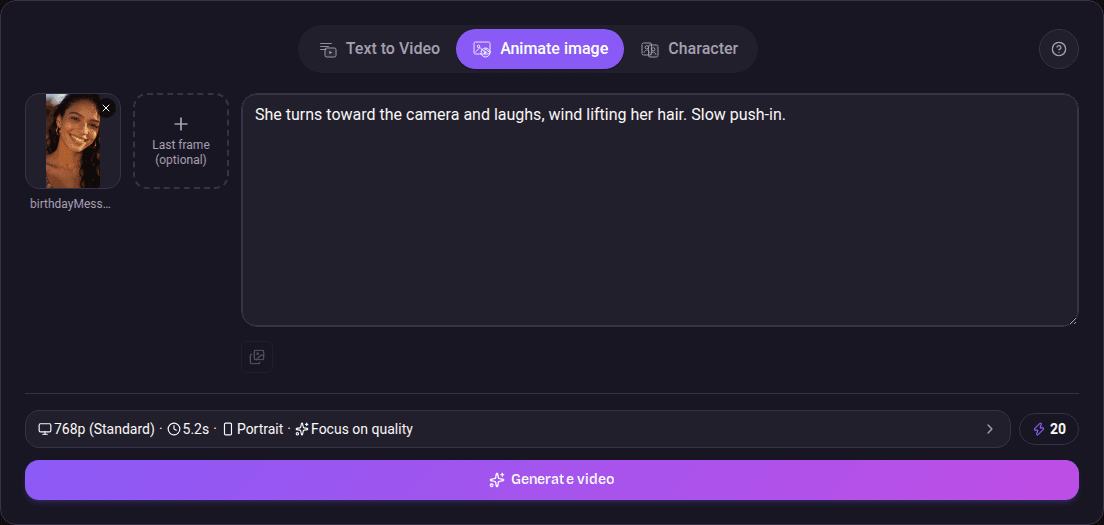
Add a photo and Kino treats it as the very first frame of your video, then continues the motion from there. Describe what happens next, like a person turning to smile or the camera slowly pulling back, rather than a new scene or a different angle. The photo is your starting point; the prompt is everything that happens after it.
Write better prompts
New to writing prompts? Keep it simple: describe one scene, one continuous action, and what you would see and hear if you were there. You don't need special words, just a clear picture in a sentence or two.
A few things that help
- Keep the camera to ONE continuous move. Asking for a cut, a new angle, or a scene change usually reads as jarring instead of cinematic.
- Describe what your subject DOES, not just how they look. Action carries the shot.
- Added a photo of a person? Describe them in a close-up. Faces get soft or distorted in wide shots.
- Direct the sound too. Say what you hear, from quiet room tone to a full musical score.
- Say what you want to see rather than what you don't, except for on-screen text: if you don't want captions or subtitles, say so directly.
Direct the camera
A few camera moves work especially well. Try naming ONE per prompt.
- Push in
The camera slowly pushes in on her face.
- Pull back
The camera pulls back to reveal the empty street.
- Pan
The camera pans right to follow the car.
- Tilt
The camera tilts up from his feet to his face.
- Tracking shot
The camera tracks beside him as he walks.
- Pedestal up
The camera rises slowly, keeping her in frame.
- Static / handheld
The camera holds steady, with a slight handheld shake.
| Push in | The camera slowly pushes in on her face. |
|---|---|
| Pull back | The camera pulls back to reveal the empty street. |
| Pan | The camera pans right to follow the car. |
| Tilt | The camera tilts up from his feet to his face. |
| Tracking shot | The camera tracks beside him as he walks. |
| Pedestal up | The camera rises slowly, keeping her in frame. |
| Static / handheld | The camera holds steady, with a slight handheld shake. |
Example prompts
Copy one of these and swap in your own idea.
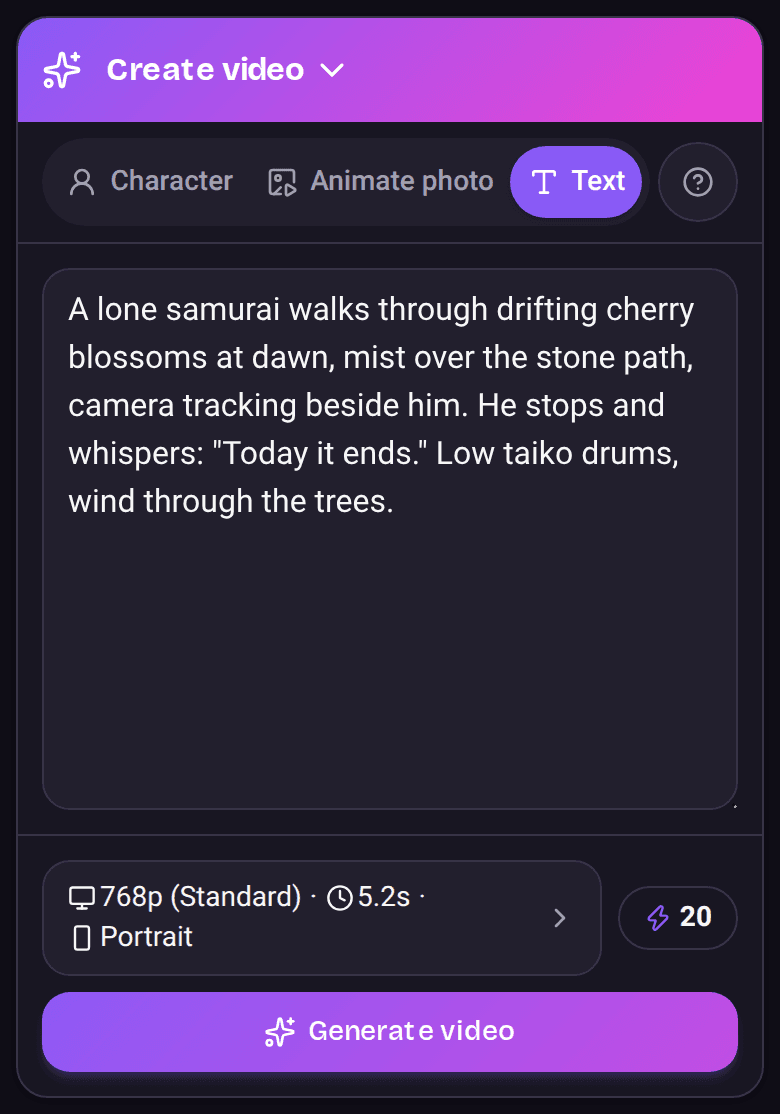
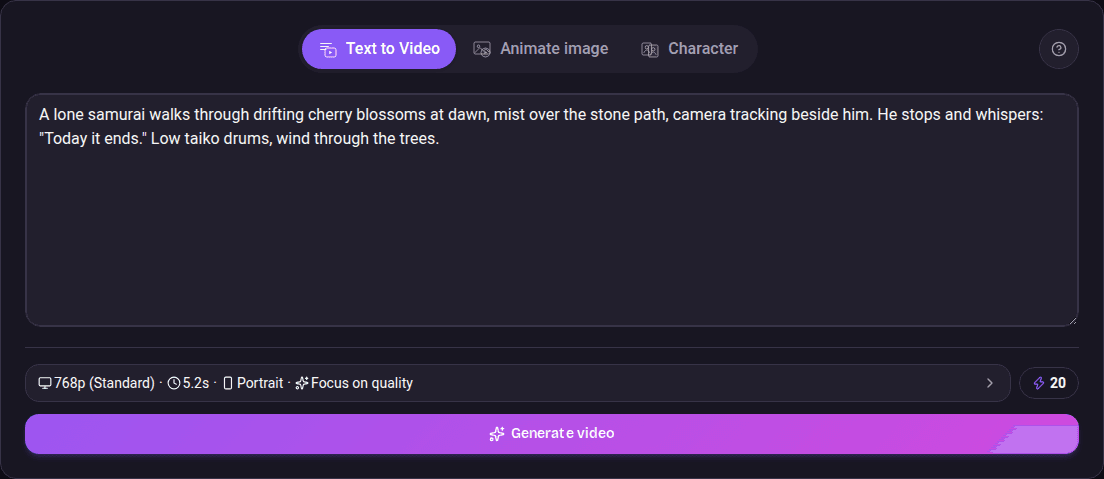
A lone samurai walks through drifting cherry blossoms at dawn, mist over the stone path, camera tracking beside him. He stops and whispers: "Today it ends." Low taiko drums, wind through the trees…
One continuous camera move, a spoken line, and a music cue, all in one clear scene.
She turns toward the camera and laughs, wind lifting her hair. Slow push-in…
It only describes what happens next and how the camera moves, since the photo already sets the scene.
A woman walks on the beach. Cut to her looking at the sunset. Cut to a close-up of her smiling.
A woman walks along the beach at sunset, the camera tracking beside her. She slows, turns toward the sunset, and smiles softly as the light catches her face.
The second version is one continuous shot instead of three requested cuts, which is what Kino renders best.
Quality and 2K
Kino can generate in standard HD or in sharper 2K. 2K looks crisper, especially on faces and fine detail, and it costs more credits than HD.
Credits
Every video that comes out uses some of your credits. If one fails, you are not charged for it, so it is always safe to try again.
Want the full reference for every field and feature? Read the documentation